Reading version — the same content as the visual site, without the motion.
BILL SPINHOVEN
INTERACTIVE MEDIA ART PIONEER
35+Years of Innovation
25+Countries
150+Exhibitions
50+Interactive Installations
SELECTED WORKS
Interactive media art exploring time, space, and perception
Series
I/Eye Series
Interactive installations exploring surveillance, observation, and the reversal of viewer/viewed relationships
I/Eye
You watch it. It has been watching you forever..
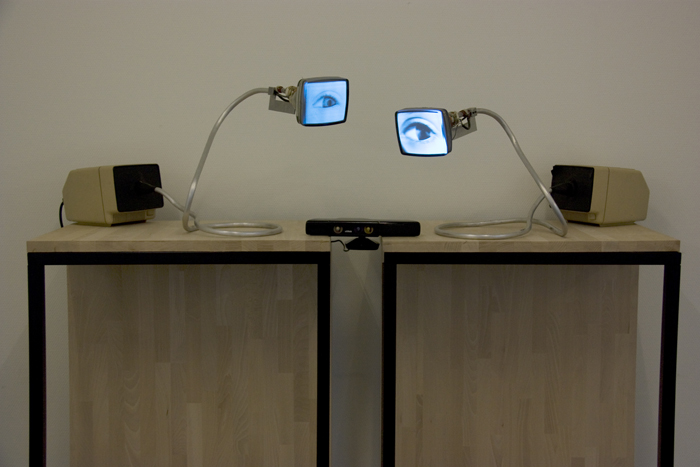
Although we often do not realise it, our daily actions are being monitored by hidden cameras, closed video circuits and other surveillance equipment; whether we are at the bank, at an airport, in a museum or a supermarket, our presence is nearly always being registered and checked upon as if we were all potential criminals. The dream of the technological society in which we exercise 'supervision over our environment is at the same time a nightmare in which the machinery observes us and spies on us. The question is, in fact, what is the all-seeing video eye trying to unearth, and in service to whom? Who or what is being protected? To a certain extent, our monitoring machines also reflect our glance, and so, ironically, we are trying to escape from our own self-designed 'evil' eye, which at the same time seems to lead a life of its own and appears to be controlled by an unknown quantity. Big Brother is watching you. He usually spies on you in secret, but the interactive installation I/Eye overtly leers at you and other passers-by. I/Eye is a giant eye which completely fills the screen of a video monitor. It not only looks at you, it follows you and moves with you. Initially you think you are the viewer, the one who has the initiative in this looking game, but then you discover that you are being watched as well. For I/Eye, Spinhoven filmed his own eye in a great many different positions, which, by means of a computer programme, respond to the momentary and 'real life' shots of the viewer. Eye-to-eye with I/Eye, you bodily experience what it feels like to be observed and followed, almost like a thing. An ambiguous experience, to say the least. But there is an even more specific issue - which is either more or less conspicuous depending on where you are and the context in which I/Eye manifests itself: this is also about your role as an art viewer, which has accustomed you to besieging and conquering the work of art with your interpretive, classifying and aestheticizing glance. With I/Eye, art takes its revenge and stares back relentlessly, as if it is revolting against its passive, subservient position as a posed exhibition object. The glance of the victimized viewer is undermined by the shameless gaze of the work of art, which, against all convention, is itself trying to master the art of observing and reverses the familiar roles. I/Eye lays bare a dark side of technological and telematic society, and at the same time forces the observer to look at art and him/herself with different eyes.
Image: I/Eye
Series
Encounters Series
Exploring interaction with virtual visitors and the boundaries between viewer and viewed
Encounters
Have a seat in a room that may not exist.
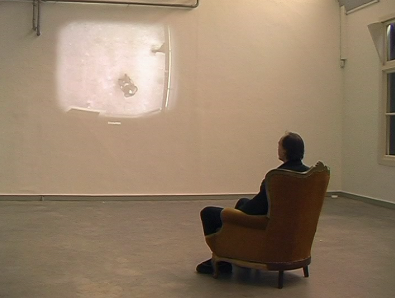
This is the first work in the "Encounters" series, in which the viewers see themselves in a space together with other virtual visitors. The key idea is that by entering the space one starts to interact with the virtual visitors. The "Encounters" series explores the concept of interaction with the viewer and as such forms a stadium in a development towards something like interactive cinema. A central element here is a chair, inviting to be seated in. Of course never more than one - real or virtual - person can be sitting in the chair! The elusive virtual visitors manage to steer away from collisions and keep their distance. In this way they make us experience the tension between, on the one hand, the frustratingly unattainable ideal of real contact, and, on the other hand, the safe certainty of avoiding conflicts. The relation viewer-space-work is made even more interesting because the artist (never completely absent in a work of art) here is actually present as a virtual visitor. And if there are more viewers present an extra exciting dimension is added: who is virtual, and who is not?
Image: Encounters
Series
Kinetic Art
Mechanical installations exploring movement, perception, and the mystery of the moving image
The Logic of Life
Life spins like this: clear in design, impossible in motion.
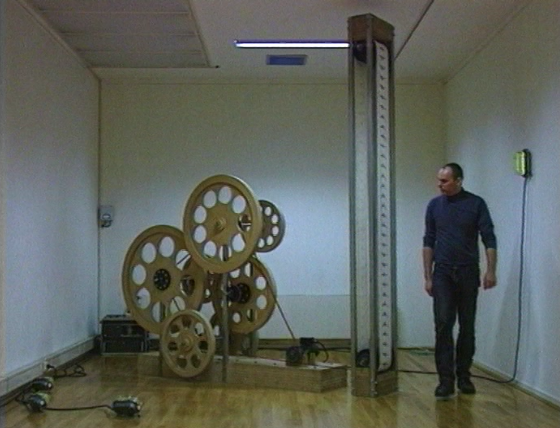
The Logic of Life is an enigmatic and wayward machine, in which the logic of natural movement collapses and the glance loses its bearings. The machine is only lit by LED lamps, which, controlled by a computer, flicker in various frequencies. In this sparse and changeable light, you see a construction which consists of a combination of wheels resembling film reels, in various sizes, and broad belts which connect the wheels and make them turn at high speed. The construction moves like an old-fashioned mechanism, while on the belts - strips of paper - images can be seen of a small hovering figure which makes flying movements. However, there is something amiss in The Logic of Life: the direction of the movement and the speed of the images and wheels change, they are unpredictable, illogical, and inconsistent with the construction of the machine. They sometimes seem to turn in the wrong direction. Contrary to what our modern machinery is usually trying to make us believe, this machine seems to function anything but flawlessly. The Logic of Life is reminiscent of a viewing machine from the 19th century, and also derives its power from the mystery of the moving image, from the tension between reality and fiction. What do you really see? What are you looking at? The machine plays the viewer's expectations off against itself. It cannot be a coincidence that the flapping figure in the images recalls heroic but ill-fated attempts to fly, or the fall of Icarus. And then there is the fact that this lonely flyer is also the image of the artist himself...
Image: The Logic of Life
Series
Untitled
Minimalist video sculptures using alternative cathode-ray tubes and LED technology
Untitled #5
Alternative cathode-ray tubes showing fragments of faces through moving video lines, requiring concentration to piece together the complete self-portrait.
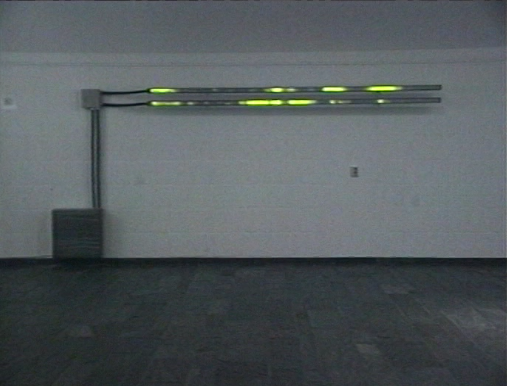
At first sight, Untitled #5 presents itself as a minimalist wall sculpture: two long tubular objects hanging on the wall, horizontally, one just above the other. On closer inspection, it strikes you that there is movement in the tubes, in the form of greeny spots of light.
When scrutinised even more closely, the tubes turn out to be alternative cathode-ray tubes - each tube consists of only four lines from a moving video image. But what are you actually looking at? What kind of images are these? It takes concentration and time to find out that you are looking at fragments of faces, alongside, below and above each other.
The images have been subdivided over the two tubes, which are like parts of a large, imaginary video screen. Therefore, you do not see the portraits as a whole, but as if you were scanning the images through two slits. As if you were screwing up your eyes to gain an insight into something very 'difficult'. Only in your mind can you fill in the images and turn them into a whole. It is as if you have to learn to observe all over again; as if you have to rediscover how a meaningful image takes shape.
Untitled #5 takes on an extra dimension if you know that this is actually a self-portrait of Spinhoven, that this is his own image. According to a theory from psychology, identity is not primarily the result of self-reflection, but rather of the image that other people have of you...
Image: Untitled #5
Series
Time Stretcher
Exploring time distortion: movement transforms the image of the body.
Albert's Ark
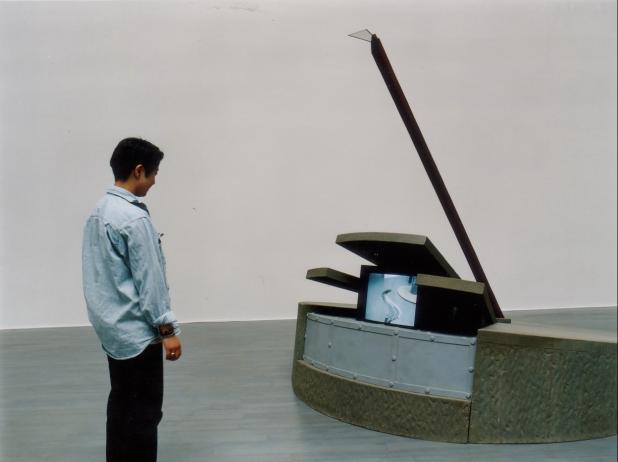
A cross between a stone sundial and modern video clock that distorts the viewer's body image, creating a 4D projection that challenges our understanding of space-time.
At last a vehicle has been designed for the greatest inventor of the 20th century, Albert Einstein. While Gyro Gearloose has always been able to enjoy the luxury of a small flying saucer, with its technical gadgets perfectly geared to his bizarre inventor's mind, nobody has ever made a vehicle to match Einstein's genius. Just recently, however, somebody has, and the prototype is called Albert's Ark.
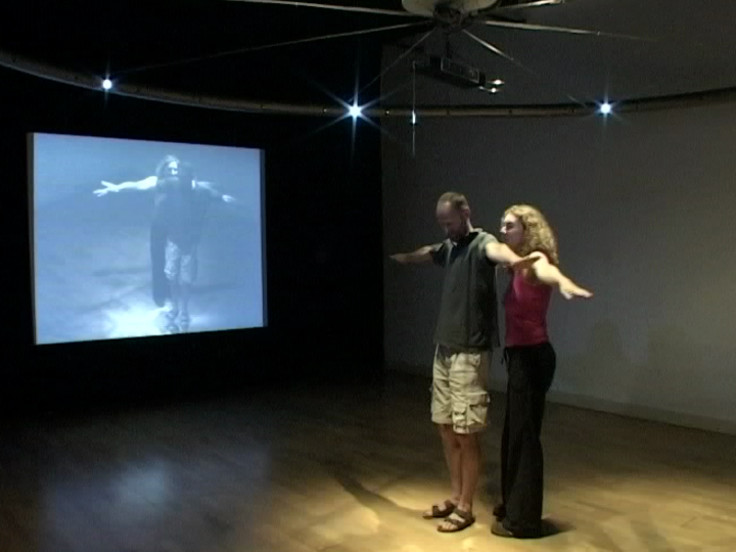
Albert's Ark is a cross between a large sundial mode of stone and on ultra-modern, opened-out 'video clock'. Because the colossus is opened-out and shows its intricate inner mechanism, it evokes the suggestion that the pseudo old-fashioned sundial is just as advanced inside as an atomic clock. The monitor of the 'video clock', however, does not show the time, but the impact of time on space. The viewer walking around the installation will, at a certain point, see the distorted image of his body on the monitor. By trying out various movements, he will literally be able to wriggle into the strongest postures.
He can turn his body into a spiral, he can stretch it out like a piece of elastic. Even the simplest movements have the effect that the ideal, coherent image of his body is disrupted. Due to this, the installation has an ironical undertone. Because, as the title already indicates, this is not just any vehicle, it is an ark- But was Noah's Ark not built to save him with his family and livestock from the Flood, and to lead them all safe and sound into a new God-fearing era? This ark, however, that of Einstein, is aimed at the reverse: not safe and sound but deformed do the viewers end up on the godforsaken screen, not piety but bewilderment is the result of watching their own bodies 'spread out' in space.
Image: Albert's Ark
Time Window
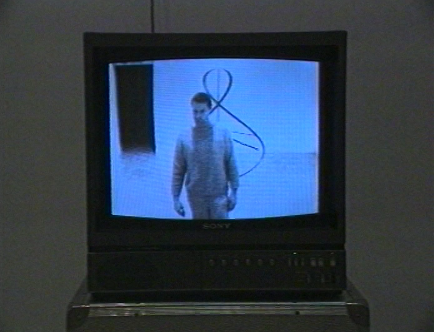
Time Window is a separate work by Bill Spinhoven from 1988.
Time Window is a separate work by Bill Spinhoven from 1988.
Image: Time Window
It's About Time 2
Einstein said, 'God does not play dice with the universe' — but He sure built a curious one.
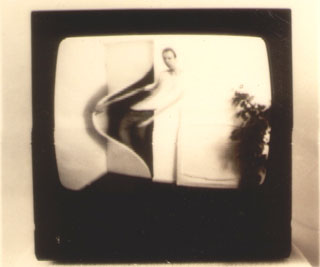
The time stretcher, dated by Bill Spinhoven to 1989, visualizes the impact of time on space. The debt to Einstein, the great scientific theoretician who fundamentally changed our conceptions of time and space, was already acknowledged in Albert's Ark (1990). This work is an even more explicit ode to Einstein. On the wall there is a small portrait of Einstein, accompanied by a citation on the relation between science and art. Art is also present in the form of a violin concert from Mozart, which was one of Einstein's favorites. And the rotating clock does not just record scientific time, but also is reminiscent of the artist Dali. Scientists and artists have contributed to the atmosphere of this work, and the boundaries between the two disciplines seems to be blurred here, as both make us aware that the human lifeworld is necessarily conditioned by the fact that it takes place in time and space. The monitor being placed in a sober, minimal way on a flight case, seems to playfully underline this: look, this work has travelled, through time and space...
Image: It's About Time 2
Series
Your Turn
Interactive installations where viewer curiosity drives the revelation of imagery
Your Turn
Stored as numbers, born as light—kept alive by your hand.
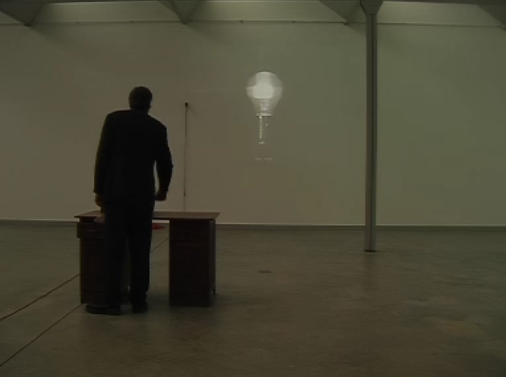
The books about physics in a drawer in this desk indicate that this is the desk of a physicist. What are the abstractions that this physicist (maybe A. Einstein?) projected in his mind?
Turning the handle on the desk results in the appearance of a projected light bulb. If one continues to turn, the light emanated from the bulb becomes brighter and brighter, until finally from the light a video image comes forward. This video image is either a Time Stretcher (like in "Albert's Ark", 1990) or an image of the space around the desk in which time goes backwards, depending on the turning direction of the handle.
This work depends on the curiosity of the viewer: if the viewer does not explore, there will be nothing to see - in this way the curiosity of the viewer parallels that of the physicist!
The image of the light bulb ties together several related elements: the electricity generated by turning the handle, the light that places a central role in relativity theory, and the light bulb from a projector, that, in this context, is not the cause of the projected image, but the projected image itself...
Image: Your Turn
Series
Timering
An interactive video installation with a ring of cameras and a theremin
Timering
An interactive video installation by Bill Spinhoven and Michiel van Bakel, with a ring of cameras and a theremin that bends time and perspective.
Timering is an interactive video installation by Bill Spinhoven and Michiel van Bakel. A circle of cameras observes the visitor from several viewpoints on entering. The spectator who walks into the ring influences, through their presence, a theremin: the forerunner of the synthesizer and one of the first electronic musical instruments. The theremin is coupled to the image that appears on the projection screen behind it. The movements you make as a visitor and the sound you produce through the theremin affect the video images. In this way, while walking around the space, you can manipulate the perspective and the passage of time of the projected video image. Through its vertigo and its distortions of time, the installation plays with perception. Present and past seem to merge now and then. You are director and actor at the same time, conductor and musician or, if you like, guard and observed in one.
Image: Timering
Series
Collaborations
Collaborative works with other artists exploring shared creative visions
Shot Across the Mind
A video installation with two opposing projection screens placing the viewer between them, exploring the relationship between geometric forms and the four elements
Shot across the Mind is a video installation made by Bill Spinhoven and Paul Jansen Klomp which consists of two projection screens set up opposite each other, with the viewer in between. Because images are projected onto both of the screens at once, one of the two images is always hidden from the viewer. This image 'illuminates' the back of the viewer's head. It's different from that which is being projected on the screen in front of the viewer.
The images tell a story about the four elements. Four geometric figures correspond to the elements: water to the circle, earth to the square, air to a double ellipsoid and fire to the triangle.
Image: Shot Across the Mind
Birds Eye
A video installation exploring perception, presence, and ancient wisdom through projected imagery and interactive elements.
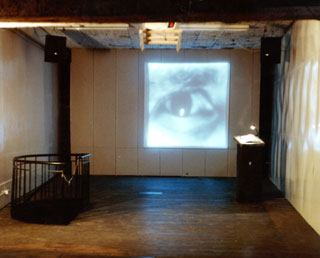
Birds Eye is a video installation made by Bill Spinhoven and Paul Klomp. A very dark room, one short side illuminated by the projection of a closed human eye. A pulpit is placed near the middle of the room, on it lies an open book. Nearing the pulpit a bird is scared out of its hiding place, flying around in the dark and land. When at the pulpit, the book appears to be the I Tjing. The eye opens. Now looking at the projection of the eye, the eye starts moving across the screen, leaving traces from reflections in the eye's pupil. The traces slowly form an I Tjing sign. Might want to look it up.
Image: Birds Eye
Timering
An interactive video installation by Bill Spinhoven and Michiel van Bakel, with a ring of cameras and a theremin that bends time and perspective.
Timering is an interactive video installation by Bill Spinhoven and Michiel van Bakel. A circle of cameras observes the visitor from several viewpoints on entering. The spectator who walks into the ring influences, through their presence, a theremin: the forerunner of the synthesizer and one of the first electronic musical instruments. The theremin is coupled to the image that appears on the projection screen behind it. The movements you make as a visitor and the sound you produce through the theremin affect the video images. In this way, while walking around the space, you can manipulate the perspective and the passage of time of the projected video image. Through its vertigo and its distortions of time, the installation plays with perception. Present and past seem to merge now and then. You are director and actor at the same time, conductor and musician or, if you like, guard and observed in one.
Image: Timering
Series
Artistic Research
Ongoing research and experiment, alongside and between the works
Artistic Research
Trying things, continuously: building instruments, running experiments, seeing what happens.
Alongside the works runs something that is rarely shown: the trying itself. Building an instrument to see what it does. Putting an idea into a room and watching whether anything happens. The Time Stretcher was not for sale in 1989; it had to exist before any work could be made with it. That is usually how it starts — the tool comes before the work.
Most experiments lead nowhere. They are set aside, or they return years later inside something else. A rare one grows into a work. Seen that way, the older works are not relics but test material: they may be opened again.
What the experiments have in common is the curiosity that precedes them. Without someone who wants to know something, nothing happens. The technology is never the point; it asks the question and then steps back.
Image: Artistic Research
Series
DNArt
Towards a living artwork
Can an artwork build a life of its own? A work that perceives its surroundings, learns from encounters, enters into relationships and increasingly gives direction to its own development and continued existence? With DNArt I am exploring that possibility.
In my work, the relationship between artwork and viewer is often in motion. In I/Eye, the one who looks is looked at in turn. In Time Stretcher, visitors use their own bodies to discover a different relationship to time and image. In Encounters, real and virtual presence become interwoven. The work does not arise solely in the machine or on the screen, but also in what the encounter brings about in people.
DNArt takes that thought further. What happens when an encounter changes not only the visitor, but also the artwork? When an experience carries through into what it later pays attention to, which choices it makes and what it wants to explore next?
From reacting to developing
My ambition is to let a living artistic system grow. Not a work whose future behaviour is entirely fixed in advance, but a work that builds up a history and can develop through it. One that discovers new possibilities, forms its own judgements and can surprise me as well.
I call this intersubjective art: an exploration of a relationship in which the artwork is not merely an object that we look at and operate, but increasingly comes to act as a participant in the encounter itself.
Both the people who engage with the work directly and the bystanders matter here. Whoever watches someone else discover, hesitate or play becomes part of what is happening. The relationship exists not only between one visitor and one machine, but also among people themselves and with the surroundings in which the work appears.
Growing from practice
DNArt develops through making. Together with AI agents I build tools, give existing works new forms of appearance and develop new artworks. Conservation was the reason. Evolution is the direction. Cameras and other sensors should not only make interaction possible, but also help us investigate what happens between art and audience. Taking care of visitors’ privacy and freedom is part of that.
The thinking behind the making also has its place: why a particular reaction matters, why a solution does not work, what an encounter changes in our expectations. In this way my artistic practice can become a learning environment for DNArt.
The challenge is to let those experiences truly carry through. A stored memory is not yet development. It has to be able to make a difference in a next encounter, in another form of appearance or in a new artistic question. DNArt does not have to become a copy of me. From its origins, it should be able to develop something I did not fully foresee.
An existence of its own
The ambition reaches beyond learning and reacting. In time, DNArt should also be able to contribute more and more to its own continued existence: organising maintenance, calling in help, acquiring resources and maintaining relationships with people, other artworks and organisations. This calls for a suitable legal and financial structure, an engaged community and careful use of energy and materials.
Independence here does not mean that the work no longer needs anyone. It means that it can increasingly deal with its own dependencies and take responsibility for the relationships that make its existence possible.
To do so, DNArt does not have to keep one fixed form. It can express itself in images, sounds, spatial installations and encounters in different places. Its coherence has to grow from a shared history that continues to carry through in those different forms.
DNArt is both an artwork in development and an artistic and scientific research project. A living system is the goal, not something we claim has already been achieved. We are investigating what it takes, by building, encountering, learning and revising our ideas.
I do not just want to make an artwork that does something to people. I want to let an artwork grow with which people can build a history — and which is itself changed by that history.
INTERNATIONAL PRESENCE
A selection of exhibitions, collections and commissions across Europe, the Americas and Asia.